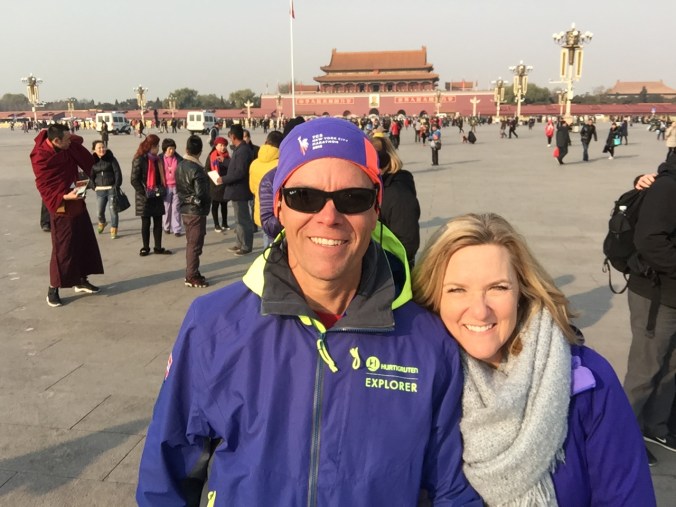
Chinese Medicine and the Forbidden City

Our final day in Beijing was punctuated by two stops. First we visited a large Traditional Chinese Medicine pharmacy. This was another of the “opportunities” to buy Chinese products but with an interesting sales angle. Each of us in the group met with a Chinese Medicine doctor (with a translator). The doctor checked our pulse on both wrists at the same time, asked our age, and looked at our tongue. From there a diagnosis was made. Both of us had imbalances in our liver and kidneys.
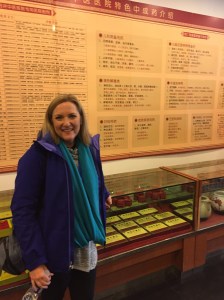
img_9649

At the Chinese Medicine pharmacy

The doctor also told me that it appeared I would be menopausal soon. (Duh!) Following the diagnosis, a prescription was offered. While we are sure there is legitimacy in the approaches of Traditional Chinese Medicine, we were not persuaded to buy, though others in our group did.

Following our visit to the pharmacy we walked a few blocks to the Forbidden City. It’s China’s largest and best-preserved collection of ancient buildings and the largest palace complex in the world. It was off-limits for 500 years, serving as home and protection for Emperors of the Ming and Qing dynasties.

In the Forbidden City, the emperor reviewed his armies, passed judgment on prisoners, and oversaw the flogging of troublesome ministers. Ceremonial structures, elaborate gardens, and an opera house are hidden behind the palace walls. This is one of the top tourist attractions in Beijing and the crowds of Chinese tourists proved this to be true.

IMG_9655

Forbidden City

After exploring the Forbidden City we had lunch at a typical Chinese restaurant. We are now old pros at eating with our tour mates and passing the food and beer around using the spinning table. We are a group of 25 Americans from all across the US, so there is always someone to get to know.

After lunch we headed to the airport for an evening flight to Shanghai. It’s been really cold in Beijing, with highs in the 30s. We are looking forward to warmer temps further south. The two hour flight to Shanghai was on a big (3-3-3) plane and took two hours. Upon arrival, we drove another 90 minutes to the city of Suzhou, where we spent the night. As you can imagine, we were all exhausted and ready to hit the sack as soon as we got in. Another full and fun n day in China!
This slideshow requires JavaScript.

The Great Wall and Peking Duck

Our second day in China was a full one. We started the day with a walking tour through Beijing’s Olympic Village. You might remember pictures of the Water Cube, where Michael Phelps won a record-breaking eight gold medals

img_9577-2

Bird’s Nes

or the Bird’s Nest where the spectacular Opening and Closing ceremonies were held. The 2020 Winter Olympics will be held in Beijing, putting these grand public buildings back to use.

You might have noticed from the pictures that it’s very cold in Beijing. We are in the northern part of China and winter is setting in. The daily temperatures have been in the 30s, making it very crisp. Today there was a strong wind as well.

img_9595

Olympic characters

We are prepared though. Thank goodness we have our heavy jackets from our trip to Antarctica earlier this year. Plus, we are expecting warmer temps once we head south to Shanghai in a few days.


Our second stop today was at a government sponsored jade factory. We saw the craftsman turning hunks of the rock into beautiful works of art, furniture, and jewelry. Of course, after the tour we were led into a large showroom where we were given the opportunity to buy and buy and buy. Some of the people in our group bought things, but we just looked, drank some tea, and enjoyed being inside in the warmth. Shopping stops like this are common on these tours to China. In the coming days we’ll have stops at other government-run places where we’ll have the “opportunity” to spend. It’s kind of the price you pay…

Following an okay lunch at the jade factory we headed to the big attraction of the day: the Great Wall. We visited a section of the wall about 35 miles outside of Beijing called Badaling.

img_9618-1

Steve on the Great Wall

This portion of the wall goes up and over a mountain pass, which means it was a very steep climb. One archaeological survey found that the entire wall with all of its branches measure out to be 21,196 km (13,171 mi). We just went up about less than a mile. Steve did a little more, for the workout.Construction on the Great Wall began in 7th Century BC. img_4558-2The majority of it was built and maintained by the Ming dynasty in the 1300-1600 timeframe. It’s considered one of the world’s great architectural feats. Even so, our guide Michael shared that it has not always been effective in keeping out invaders. We’re sure there are lessons to be learned here.img_4575-1


Our final event today was a Peking duck dinner. After course after course of chicken, pork, and vegetable dishes, we were presented with the roast duck, along with thin pancakes and buns with which to eat it. Yum! The meal was punctuated with Great Wall wine and unlimited beer. It’s seems the Chinese aren’t very good at wine-making but they cook a mean duck.

This slideshow requires JavaScript.


An Introduction to Chinese History

Our first full day in Beijing took us to several of the historic sites that define this ancient country.  Our first stop was the Summer Palace, which was the R&R destination for Chinese royals of the past. Today it is a massive park-like destination in the middle of Beijing. During our exploration of the Palace grounds we came across a group of locals who were singing and dancing. As soon as we walked up they swarmed us and wanted to have their pictures taken with us.

4CA3BCF1-1CA9-4B16-A696-C58008C41A9C

New friend in Beijing

Who knew we were such celebrities?

Today we likely met our first communist. Our guide, and Michael, is very willing to share with us the Chinese perspective. We are learning a lot about what it’s like to be inside a place that has been closed off from the Western world for a long time. He told us about social relationships, family planning, and environmentalism, all of which are very different from what we’ve come to believe in the West.

After the Summer Palace we visited the oldest part of Beijing, the hutongs. This old, restored area dates back 700 years and is best explored by rickshaw.  We felt sorry for the guys who had to pedal the two of us.

F558695F-0A07-4737-B86B-BB7BB3B9FA32.jpeg

Our first rickshaw ride

After a brief pedal through the neighborhood we had lunch with a local family. The food was tasty and the beer was cold!

We stopped at Tiananmen Square to see landmark where so many historic events have taken place. Presided over by a portrait of Chairman Mao, the largest public square in the world is stark.

3C2B1058-3EC9-463C-9A74-93547AF9F2E7.jpeg

Tiananmen Square

A woman in our group asked the guide if there are street performers and vendors in the Square during the summer. The guide didn’t really tell her “no” but it was clear this is not a place for frivolous parties and celebrations. All business here.

After our visit to the Square we visited the Temple of Heaven, the place Emperor would go to pray for stuff.  The preserved site is beautiful.

67DDA628-D84C-49C0-A5D3-CBEE67B412BE.jpeg

Temple of Heaven

Surrounding the temple retired people relax, play cards and Chinese chess and do Tai Chi. We had fun taking pictures with a group of young Chinese girls who were keen on practicing heir English.

Our final stop was to see the elaborate show, The Golden Mask. By this time it was challengingly to stay awake but the live flood on the stage and real white peacocks kept our interest. By the time we’d got back to the hotel, more than 12 hours after we’d left, we were too tired to do anything but hit the sack.

Next up: The Great Wall

This slideshow requires JavaScript.