Miami Beach of South America – Punta del Este

Several years ago we spent a Christmas night in the small village of Colonia de Sacramento, Uruguay as part of our visit to Argentina. We loved Uruguay then and it didn’t let us down this time around. Our Antarctic cruise concluded in the Uruguayan capital of Montevideo and we spent one day exploring the city. We watched our ship, the MS Fram exit the harbor and sail out the Rio de la Plata on its way to the Amazon and then on to the Arctic.

1.1489957587.waterfront-in-montevideo-fram-in-the-backgroun

Along the Rio Plata

We also acted on numerous recommendations to eat at El Palenque. This is the most famous Uruguayan barbecue place, located in the old port in Montevideo. You’ll see from the pictures that we had a great seat to watch the expert chefs prepare the world famous meat and vegetables on the large grill.

After a night in Montevideo we rented a car and drove to the beach resort of Punta del Este. Punta del Este is located on the confluence of the Rio de la Plata and the Atlantic Ocean and is the home to summer fun for the rich and famous of South America. Beaches lined with shining high-rise condominiums owned mostly by Argentines, the area is also home to big yachts and very modern homes. We stayed at the Conrad, a big hotel and casino, which is the site of many events and conventions. This weekend there was a weird car race around the front of the hotel on Saturday night as well as a road bike race on Sunday morning.

One of the draws of this area is the burgeoning wine industry. In the past decade, young, creative winemakers have begun developing vineyards in the farmland around Punta del Este. In addition to Tannat wines, the area is becoming well known for producing great sauvignon blancs and merlots. We visited two of the newest bodegas around Punta del Este and were impressed with the wines, as well as the interesting buildings in which they are made.

On one day we drove to Viña Eden, a newly opened bodega north of Punta. While tasting several great wines we chatted with Juan Pablo, the winemaker and his cute wife Veronica. We then drove to the beachside town of Jose Ignacio, where we watched the big waves crash around the lighthouse. While there we met this guy from Argentina who was excited to talk to us as soon as he realized we were American. His dog was named Obama (dog tags were proof) and we just “had” to meet Obama! One of many fun encounters on this adventure!

While on trips like this we like to do a tour once in awhile to give us a different perspective on a place. Here we booked a wine tour with The Wine Experience, led by South African Ryan Hamilton. On Friday evening Ryan picked us up and took us to Restaurant and Bodega Narbona for a private tasting of this small vinyard’s wines. From there we went back out to Jose Ignacio, up the coast, to a private tasting at the exclusive Playa Vik hotel. We arrived just in time for sunset and enjoyed taking pictures around the negative edge pool, overlooking the Atlantic Ocean. The property features very modern furnishings and artwork, which you can see in the photos. The wine was great too!

On our final day in Punta del Este we drove out to Bodega Garzon, a new and very large operation that is redefining Uruguayan wine. Here we took the harvest tour, which included the opportunity to cut grapes in the vineyard.

We both decided that while it was fun for a few minutes, we didn’t need to do it for days on end and we have a new respect for the workers who harvest grapes for our wine. It’s backbreaking work, and at Garzon, all 500 acres are harvested by hand! The harvest was followed by a tour of the newly opened bodega, which features production facilities underground. We highly recommend a visit to Garzon, for the wine and the scenery.

We then drove back to the beach of Jose Ignacio to have lunch at the acclaimed La Huella. This popular beach restaurant draws crowds from Argentina and Brazil and it was packed! Luckily we had a reservation and enjoyed great fish and wine with a view. Our day finished up with another spectacular sunset at the famed Casapueblo, an elaborate building constructed by the Uruguayan artist Carlos Páez Vilaró. It was originally a summer house and workshop of the artist, and is now a museum, an art gallery, a cafeteria and a hotel. It was the perfect end to a perfect stay in Uruguay and to an incredible South American/Antarctic journey.

We are looking forward to spending some time at home in Prescott and Puerto Peñasco over the next few months, while planning our next adventures. Thanks for following along!
 

This slideshow requires JavaScript.

The Falkland Islands

We spent our first of three days in the Falklands in the main city of Stanley. The Falklands are a British territory, yet have a storied past with claims to the islands from France, Spain, and of course, Argentina. The 1982 Falklands War most recently clarified Britain as the rulers of this far away place.

The city is not much of anything. There is a museum, various war memorials, including a bust of Margaret Thatcher, a handful of pubs, and that’s about it. The real interest here is in the outer islands where we’ll see more unique wildlife in the coming days. For this stop, we checked email, had a locally brewed beer, and bought some souvenirs.

On Thursday, March 9, 2017, our first of two stops today was at New Island, Falkland Islands where we endured a rough landing. The weather was grey and windy, and the swells were pretty high. Needless to say, it made for a fun and wild ride in the Polar Circkel boats to the land. We got a little wet, but our rain pants and muck boots kept us warm and dry.

1.1489513258.waiting-for-the-tender-back-to-the-ship

Waiting for the PolarCirckel Boat on New Island, West Falkland Islands

New Island is one of many islands on the western side of the Falklands. There is a small settlement with a few residents, and they were at the landing site to greet us. It seems the arrival of a cruise ship with 200 passengers is a big event in these parts.

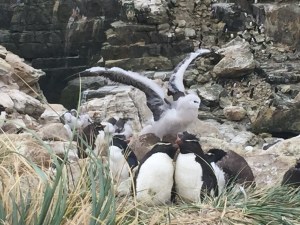
On New Island the big attraction is the Rockhopper penguins. This was our first sighting of these penguins, and they are really cute. They have a little tuft on top of their heads and white markings near their eyes, which make them look a little evil. Mostly, however, they just sit on the cliffs and endure the wind. They live among Black-Browed Albatross, which are the biggest birds in the skies here. We enjoyed sitting and watching the large birds stretch their massive wings.

After communing with the Rockhoppers and albatross we climbed to an overlook for a panoramic view of the surrounding islands. Desolate is one way to describe it.

1.1489513258.more-rockhoppers-a-baby-albatross

Rockhoppers with an Albatross

Our second landing today was to nearby Carcass Island. We didn’t have a lot of time here, but we did partake in the island’s highlight: cake. Rob and Lorraine McGill have lived on Carcass for 40 years raising sheep. Now they entertain the few cruise ships that stop by opening their home and serving tea and cakes. We enjoyed the hospitality and a warm drink before going back to the ship.

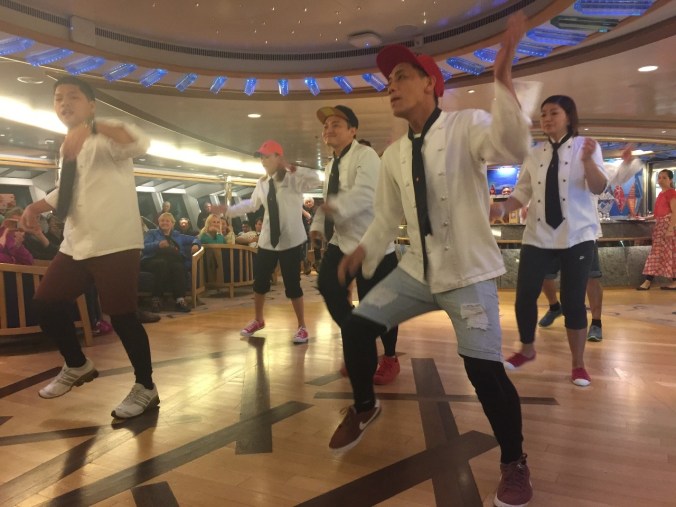
On an expedition ship like the MS Fram, you won’t find the usual cruise ship features that we’ve come to expect. For example, there is no casino, no fancy productions, and only a small shop that sells essentials. Instead of bingo or art auctions, the cruise features lectures from the on-board expedition team, all of whom are experts in their respective fields. The team included marine biologists, ornithologists, geologists, and many other –ologists. Most evenings we went to bed early, as there were no song and dance shows or other spectaculars. One exception, however, was the crew show, which featured dancing and singing from the crew members. Many of the service crew members are from the Phillipines, so we were entertained with native dancing, karaoke singing, and more dancing.

1.1489513258.crew-show-on-the-ms-fram

Crew show fun

It wasn’t like the Broadway-like shows you see on a big cruise, but there was something special about seeing your favorite waiter dance and sing. We’ve included a few photos of the show.

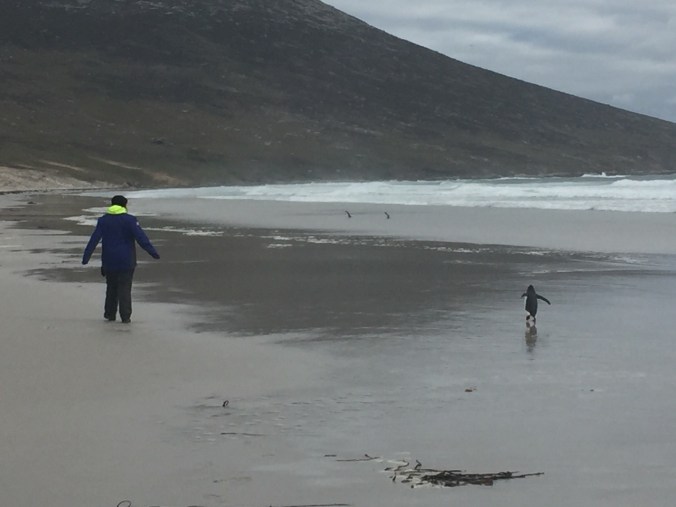
The final landing of our adventure was on Saunders Island, West Falkland Islands, also part of the Falklands. Saunders was originally settled in the 1700s by the British and is now home to a lot of sheep. Again, the local shepherds came to the landing to greet us. Saunders is home to the best variety of wildlife we found in one place. During our two mile stroll along “the neck,” we found huge colonies of Gentoo and Magellanic penguins, King penguins with chicks, and Rockhoppers up on the cliff. Of course, there were also sheep.

1.1489513258.marnie-as-one-with-the-penguin

Marnie and a penguin friend

The weather was perfect for our visit, with light winds and even a little bit of sunshine. All in all, Saunders Island was the perfect way to top off our exploration of the South Atlantic islands. After three relaxing days at sea, we arrived in Montevideo, Uruguay and concluded the cruise portion of our trip. Next we’ll head out to the “Miami Beach of South America,” Punta del Este, Uruguay, where we’ll spend our final week soaking up the southern sun. More to come…

This slideshow requires JavaScript.

South Georgia Island

What do half a million penguins look like?

After a rough two days at sea crossing the Southern Ocean we made landfall at South Georgia Island. South Georgia was the center of the Antarctic whaling industry in the early 1900s and is best known as the location of Sir Ernest Shackleton’s landing at the end of the Endurance expedition (more on that later).

Today our destination was St. Andrews Bay and it was spectacular! Amidst a snowstorm that at times created white out conditions, we met the over half million king penguins who make this bay their home. King penguins are the second largest penguin species on Earth, with the Emperors being the largest. St. Andrews Bay is home to one of the largest King penguin colonies anywhere and to see all those creatures span across the snowy landscape was unbelievable! Once we got on to land and started to walk among them, we found them to be friendly and curious.

1.1489319612.happy-pair-of-king

King penguins

Each grown King penguin is 2 ½ to 3 feet tall and the average weight is around 30 pounds. So, imagine a half million toddlers waddling around and squawking all at once.

Among the King penguins were many fur seals and their pups. The pups reminded us of our dogs, Mia and Nica as they were playful with each other and ornery at times. Some of the young seals tried to test their strength by charging toward us but the ship’s crew were right there showing us how to make ourselves look bigger and the seals seemed to back away.

On March 5, 2017 we visited two sites on South Georgia Island. Our first stop was Grytviken, South Georgia’s first and longest running whaling station. It operated from 1904 to 1965. At its peak in the 1937-38 season, South Georgia’s deep sea whaling operation killed over 46,000 whales, almost 90 percent of the world’s catch for that year. At that time South Georgia had over 2000 inhabitants. Today there are only three permanent residents who are government officers and in the summer there is a staff at the South Georgia Museum, which we visited.

Grytviken is a fascinating place, for the whaling history as well as for the role it played in the Shackleton expeditions. Sir Ernest Shackleton led the Imperial Trans-Antarctic Expedition in 1916. After the expedition’s ship, the Endurance, was crushed by ice and sank far to the south, the men made a treacherous journey over the sea ice and across the ocean to finally reach land on Elephant Island, Antarctica. A smaller contingent of the crew then set sail for South Georgia by small boat to seek help. The journey across the Southern Ocean took 15 days until they landed on the west side of South Georgia, only to have to hike across the icy, mountainous, glaciated island to reach the whaling station at Stromness (our afternoon landing location).

While in Grytviken we visited Shackleton’s grave in the Whaler’s Cemetery and saw remnants of the expedition, as well as artifacts from the whaling era in the South Georgia Museum. While at the small church I rang the bell for Mom.

1.1489319612.shackleton-s-grave

Saluting Sir Ernest Shackleton

Our second landing today was at the old whaling station Stromness. The relics of the old operation are still standing, albeit rusting and off limits due to asbestos. Fur seals have overtaken the area and were the main attraction at this stop. We saw fur seals nursing, an albino pup, and one very large Elephant seal on the beach.

Steve took the longer hike, through an on and off again snowstorm to the waterfall Shackleton crossed during his heroic landing on South Georgia. Winter is definitely knocking on South Georgia’s door. We were lucky enough to be here for the first big snow of the season. Our ship-supplied expedition jackets and muck boots kept us warm though, and it was a great visit.

After South Georgia we had a two-day sail to our next stop: The Falkland Islands.

This slideshow requires JavaScript.