El Chalten: The Hiking Capital of Argentina

El Chalten, Argentina is considered the trekking and climbing capital of Argentina, and it is now officially one of our favorite places on earth! The town was established in1985 to secure the disputed border with Chile. Now it is the access point to the northern sector of Los Glaciares National Park, at the base of Cerro Torre and Cerro Fitz Roy mountains. Both mountains are famous with climbers, and the area is a popular base for hiking the numerous trails.

The hiking trails are accessible right from the town and all are well marked and easy to navigate. On our first evening here we braved the strong winds and rain to tackle two overlooks above the town: Mirador de los Condores and Mirador de los Aguilas. These trails were a good warm up to the big one: Laguna de los Tres. The Laguna del los Tres trail is a little over 10K, or about 7 miles one way, and it leads to a beautiful lake at the base of Mount Fitz Roy. If you’ve ever seen the beautiful snow-covered granite spires on your screen saver, then you’ve seen Fitz Roy. 1.1486976773.mirador-de-fitz-royWe’ve now seen it from our bedroom window at all hours of the day and night and up close from Laguna del los Tres. Our hike was long and at times grueling, but totally worth it! The final kilometer was a steep 400 meter climb up rocks and scree in a pretty fierce wind. But, once you got to the top, you forgot about the challenge of the climb. Seeing Fitz Roy up close is why we travel so far.

The second major hike from El Chalten is to Laguna Torre, which is a the base of the other large spire, Cerro Torre. Steve went to the top of this 15 mile climb on our second day here while Marnie went to the spa! We both climbed to the overlook the following day to catch a glimpse of the mountain. Again, words can’t describe the majestic nature of this landscape, even on a cloudy day.

Steve celebrated his birthday here in El Chalten, and we marked the big day with a trip down the Rio de las Vueltas on a rafting trip. Our guide, Lolli is a member of Argentina’s EcoChallenge team, and he’s competed in the adventure race in Morocco, Borneo, Argentina, and Ireland. This guy knew how to navigate a raft through the rapids! After we put on dry suits, our group of six plus Lolli boarded our inflatable raft and began to float quickly down the river.

1.1486976773.taking-a-swim-in-the-dry-suit

Steve testing out the dry suit

Through class 3 and 4 rapids, we paddled like crazy to stay upright. Two of our fellow rafters were thrown out of the raft in a particularly rough part of the river, but no one was hurt, and we remained on top of the raft the entire time. Steve did take the opportunity to try out the dry suit at the end of the trip and jumped into the river. All in all it was an adrenaline-filled morning that we would do again in a heartbeat.

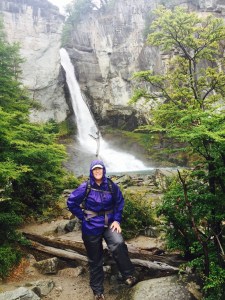
Our time in El Chalten finished with two days of rain, with the mountains obscured by the clouds. Even in the rain we did a few small hikes in the area…good rain gear is essential here. 1.1486976773.chorillo-de-salto-on-a-rainy-dayIt was a bummer but at least we had a few good days of hiking with great views. Many hikers come for just a day or two and never see the mountaintops. Our advice: come and stay for awhile! This little mountain town is peaceful, slow-paced, and very cool.
Now we are moving south to the “end of the world,” Ushuaia, Argentina, where we will explore for a few days before boarding the ship to Antarctica. Hope you enjoy the pictures of El Chalten!


This slideshow requires JavaScript.

Ice Trekking on Perito Moreno Glacier

We’ve spent the last few days on the shores of Lago Argentino in El Calafate, Argentina. This tourist town is the base for excursions to the nearby glaciers and Los Glaciares National Park. We took a day or two to explore the town and enjoy the views. El Calfate caters to tourists, so there are lots of souvenir shops and mountain outfitters. Of course, there are also many great restaurants to try. We made the most of our time in El Calafate, using it as a base for our ice-related excursions.

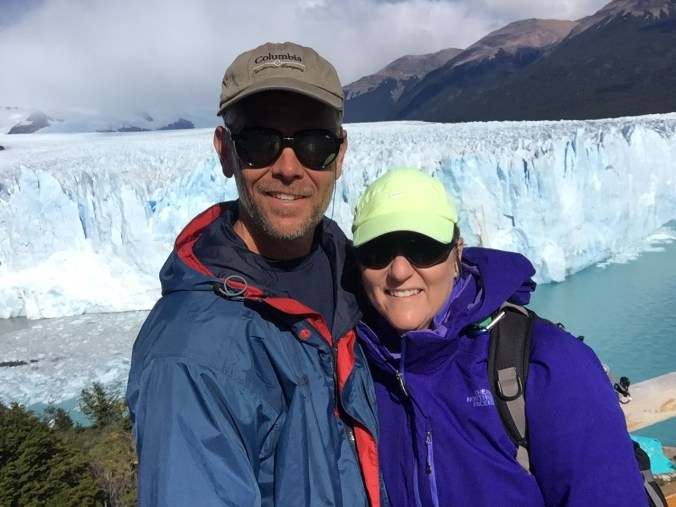
Our first big adventure was to see Perito Moreno Glacier, which is the reason most people come to El Calafate. We took the full day mini-trekking trip with Hielo y Aventura. Boy, this operation was efficient! First they picked us up in a comfortable bus and drove for about an hour and a half along the shores of beautiful Lago Argentino. Once arriving to the national park, we had about two hours to view the massive glacier from a network of strategically placed walkways. We could hear the ice shifting and occasionally watched large pieces of ice fall into the lake with a loud roar. Each calving is literally breathtaking!

1.1486641457.in-front-of-perito-moreno-glacier

In front of Perito Moreno Glaciar

Perito Moreno is part of the 97 square mile Southern Patagonian Ice Field, and is one of 48 glaciers fed by the system. This ice field is the world’s third largest reserve of fresh water. Perito Moreno is unusual in that it is stable, not advancing and not receding, while most glaciers worldwide are retreating. The face of the Perito Moreno Glacier is 5 kilometres (3 mi) wide, with an average height of 74m (240 ft) above the surface of the water of the lake. It has a total ice depth of 558 feet. That’s a lot of ice!

After a nice lunch we traveled by boat across the lake to the shore adjacent to the glacier. After a short hike we strapped on crampons and were led across the glacier.

thumbnail.large.1.1486641457.putting-on-the-crampons

Getting our crampons

To say this was an incredible adventure is an understatement. It took a few minutes to get used to walking with spikes strapped to your shoes, but once we got comfortable, we could see the wonder around us. The sparkling ice with various shades of blue reflecting from deep crevasses was spectacular. At one point we refilled our water bottles from a pool of blue ice and it was the most delicious water we’ve ever tasted. Our hour and half on the ice flew by. At the end of the glacial hike we were treated to a celebratory drink of whisky on freshly chopped glacial ice. The pictures just don’t do this adventure justice, but we hope you enjoy them!

thumbnail.large.1.1486641457.whiskey-anyone

Our day on the ice was supposed to be followed by a day in the ice…well, paddling around in it. As many of you know we love to kayak and the opportunity to kayak along one of the largest glaciers in the world was too good to pass up. We joined a group of 12 other adventurers and set out onto an arm of Lago Argentino to kayak among the icebergs around Upsala Glacier. Unfortunately, the winds were so strong that we were unable to kayak. With wind at over 30 knots and waves crashing over the large boat, it was just not safe to get into the water. Of course we were disappointed but the scenery was spectacular and the crew was professional and transparent about the situation. We received a refund and booked a river raft trip for the next week with the same company. Unfortunately we didn’t get any pictures, as we didn’t bring our cameras. We were to have an on-board photographer capture the adventure, but since we didn’t get to kayak, we’ve got no pictures of the journey. Oh well.

Next stop is El Calafate, the trekking and climbing capital of Argentina.

This slideshow requires JavaScript.

Trekking Torres del Paine National Park

For the past week we’ve been off the grid, exploring one of the world’s most incredible wildernesses. Torres del Paine National Park is the pride of Patagonian Chile and attracts tourists and hikers from around the world. We spent 7 days in and around the park, tackling the famous W trek, as well as a few other choice spots in the area.

We stayed at the highly rated EcoCamp Patagonia in a standard dome. While we upgraded on the first night to a suite dome with a private bath, we were unable to reserve the more luxurious accommodations for the entire stay. Thus, the standard dome and the shared bath wasn’t the most spacious and swanky lodging we’ve ever had, but it was a lot better than a tent!

thumbnail.large.1.1486420735.our-little-dome-7

From our dome window we could see the Torres, the highlight of the park, and the stars, sunrises, and sunsets were amazing. We were not overwhelmed with the EcoCamp service but the surroundings made up for the lack of attention to detail at the facility.

On the seven hour drive from Punta Arenas to EcoCamp we stopped at the Cueva de Milodón, The large wave-like grotto was home to the prehistoric mylodon, a giant ground sloth that has been extinct since humans arrived in the area. His (her?) bones and manure were found at the site and have been carbon dated at roughly 10,400 years BC. The mylodon was basically an early Big Foot. And, the cave provides a nice opportunity to stretch during the long trip to Torres del Paine.

The primary reason for visiting Torres del Paine is to attempt the Classic W trek. This is a four day hike on the park’s most famous trails. Our group of 10 hikers and two guides set off on Tuesday morning to a clear blue sky. On this day we hiked from EcoCamp to the Cuernos Refugio, which was about an 8 mile stroll along the beautiful glacial Lake Nordenskjold. The refugios in the park consist of primarily bunk houses with very mediocre food. At the first night’s refugio we were happy to learn that EcoCamp was able to reserve us a cabana, which was a little A-frame cabin for two. The privacy was a nice surprise, even though we had to walk outside a few steps to the shared bathroom.

1.1486420735.a-little-windy-on-the-trailDay two of the trek is to the French Valley. The 16 mile hike is one of the harder paths in the park. It was a 10 hour day but the views were totally worth it. Steve went to the furthest lookout, while Marnie turned around after the first lookout, saving about 3 hours and 3 miles of uphill walking/climbing. Still, it was a long day for everyone. We finished this portion of the hike at the Paine Grande Refugio, which is perched on the banks of Lago Pehoe. Here we shared a room in a bunk house with four fellow hikers. Since we’d all been hiking together for several days, we were all friends by this point and enjoyed the experience, which of course included a nice bottle of Chilean wine.
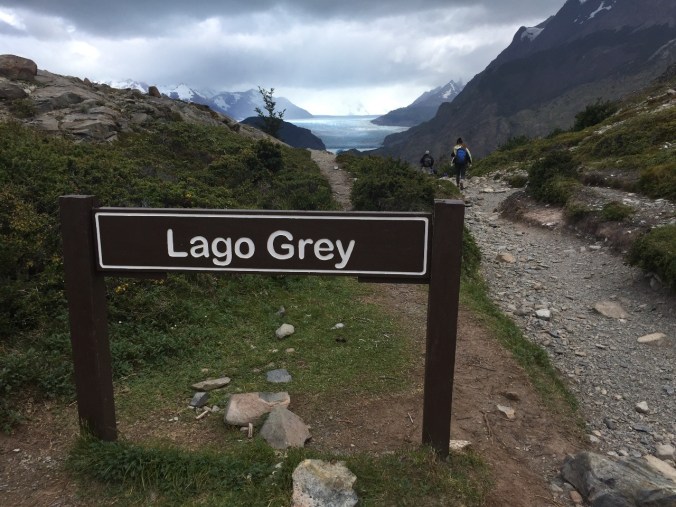
By the third day, after two nights of refugio living, shared bathrooms, and pretty crappy food, we were ready to return to EcoCamp’s luxuries. Before that, however, we completed another 7 mile hike, ending at the Gray Glacier. The views of the glacier were spectacular and once we reached the end of the trail, we boarded a boat which took us close to the glacier wall to see the sparkling blue ice in detail. 1.1486420735.lago-grey-trailThere was even a large floating piece of ice that had broken off the glacier three months before. The iceberg had formed an arch and was a spectacular site. After the cruise we returned to EcoCamp for a tasty meal accompanied by good Chilean wine. The Carmenere is now one of our favorites.

The fourth day of the trek completes the W, which is the shape the trails forms on the map. We awoke to a rainy and foggy morning. The signature hike to the Torres, or towers of granite, is another 14 miles path, pretty much straight up. After three days of hiking, Marnie took a break on this day, and Steve tackled the challenge without problem.

We finished our time with the group of 10 with an easy hike on the Fauna trail, which is about 6 miles through the habitat of the guanaco. Guanacos are a cousin to the llama and are prolific in and around Patagonia. We were able to get very close to these exotic creatures, along with their babies. Here guanacos live in large herds of females and chulangos (babies), with the males fighting for the right to the herd. We saw some of the competition between males and even saw guanacos breeding. Babies are born between November and February, so we saw lots of little ones. Amidst the guanacos you’ll also find rheas, which are like ostriches, only smaller. This place is truly incredible.

To top it all off, we spent our last day in Torres del Paine tracking the elusive Baguales. Baguales are Chile’s version of the mustang, and there is a herd of 100 of these wild horses living in a remote area of Torres del Paine. We joined six other travelers for a full day of learning about the horses, hiking off trail to find them, and finally watching them graze, play, fight, and breed from a distant hilltop. These aren’t just any old horses. The herd has some unique behaviors that scientists are now trying to study. First of all, the stallions co-exist in the herd, which is very unusual. We were led by Victor, who is a veterinarian by training and has a passion for studying and preserving these beautiful animals. We learned about his research and his ambitious plans to protect and preserve these beautiful creatures. Our day finished up at Lago Azul (the blue lagoon) with a traditional Chilean barbecue of beef, lamb, chicken, and chorizo served with great Chilean wine and homemade ice cream. It was the perfect way to end our exploration of this incredible place.

We’ve now traveled by bus from EcoCamp to the Argentine town of El Calafate where we’ll spend the next week exploring the region’s glaciers and trails. More to come on that in the next blog post.

Thanks for following along!

This slideshow requires JavaScript.